Business Impact Analysis Template: What Most Miss Until It’s Too Late
November 11, 2026

A business impact analysis template that skips recovery time, recovery point, resource dependency, financial impact over time, or legal exposure leaves hidden gaps. These gaps only become visible during a real outage, when it’s too late to fix them.
Picture a mid-size firm in Charlotte losing its order-processing system at 9 a.m. on a Monday: by noon, nobody can say which supplier to call first, how much data is gone, or whether a client contract has already been breached.
That scenario is exactly what a business impact analysis template exists to prevent, yet many templates leave the answers to those questions blank.
A usable template does more than list processes and estimate downtime. It connects what a business needs to survive with what could go wrong if a single detail gets missed.
A business impact analysis (BIA) identifies which activities are critical, how long the business can operate without them, and which resources those activities depend on. Skip a thorough approach here, and the continuity plan built on top of it carries gaps that stay invisible until a crisis makes them impossible to ignore.
That's precisely the problem for most businesses in Charlotte: a plan needs to prove itself solid before an outage, not during one. Seen that way, it's worth examining what a complete BIA template actually has to include.

Why most business impact analysis templates fall short
Many templates look complete at first glance, listing critical business functions and asking for a downtime estimate. Looking complete and being complete are different things, though, since a standard template rarely pushes further to examine every angle a real disruption will test.
That shortfall shows up the moment something actually breaks. If a plan never defined how much data loss is acceptable or which resources each process depends on, the response team ends up improvising answers under pressure instead of following them. The gaps in the analysis stop being theoretical at exactly the moment they can least be afforded.
A template that skips recovery time objectives, recovery point objectives, resource dependencies, financial impact over time, and legal or contractual exposure leaves a business exposed on five separate fronts at once. Each of those elements closes a specific gap that would otherwise catch a team off guard.
The hidden costs of incomplete business continuity planning
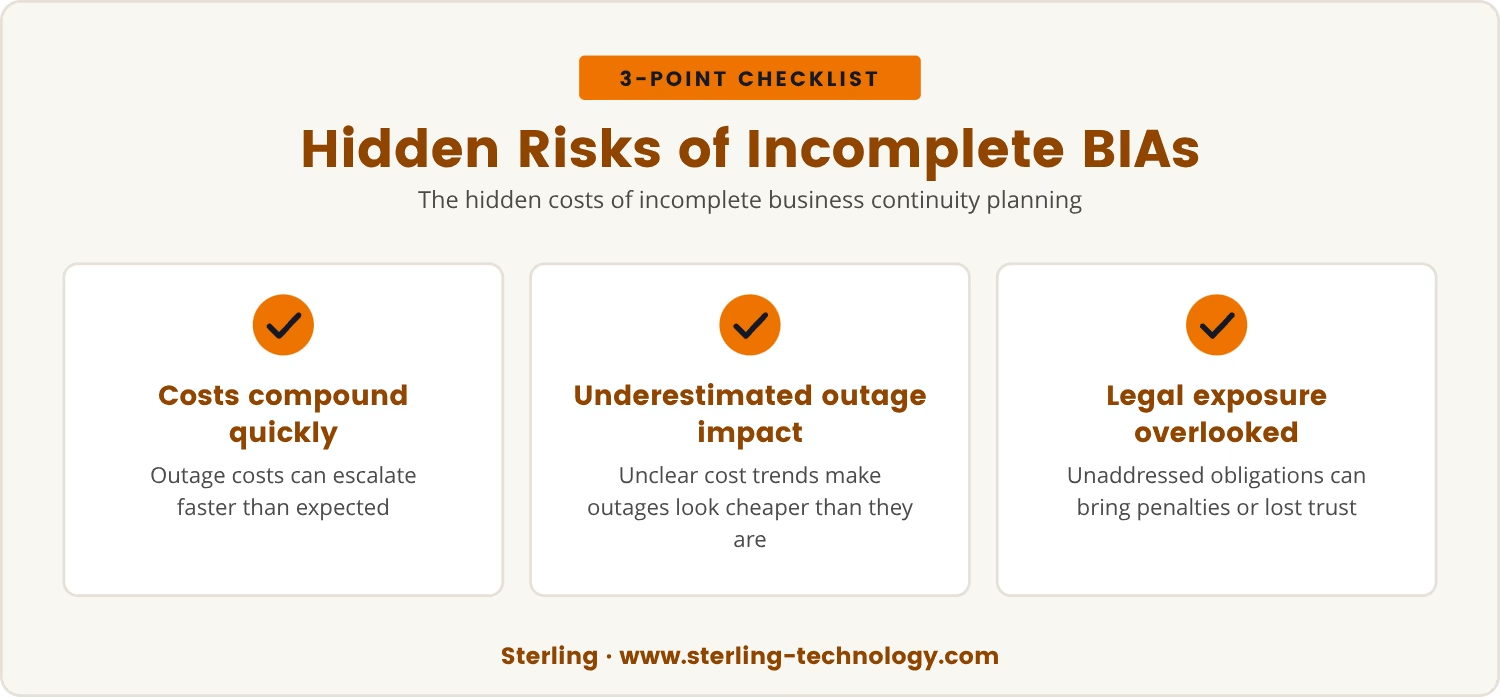
A business continuity plan built on an incomplete BIA creates risks that stay hidden until it's too late to address them cheaply. Miss a critical dependency in the analysis, and systems might get restored in the wrong order or a key supplier gets overlooked entirely.
Financial consequences compound from there, and quickly. Without a clear sense of how costs shift the longer an outage drags on, a business can underestimate the true impact — and decisions that looked reasonable on paper end up costing far more once they play out.
Legal and contractual obligations round out the blind spot. Leave them unaddressed in the plan, and penalties or lost customer trust can follow, a risk sharpened for businesses in Charlotte by local regulatory and contractual nuances.
Every missed detail in a BIA eventually turns into a real-world consequence. That's the case for looking beyond the basics and confirming the template covers more than the obvious.
Five elements your business impact analysis template must include
A truly usable business impact analysis template covers five elements that informal versions routinely skip. Each one closes a gap that would otherwise leave the business exposed during an outage.
Recovery time objective (RTO)
This defines how quickly a process or system must be restored after a disruption. Without a clear RTO, a team has no way to know which activities to prioritize first.
Recovery point objective (RPO)
RPO sets the maximum amount of data loss the business can tolerate. Leave it undefined, and the risk is losing more information than the operation can actually absorb.
Resource dependency
Every critical business function relies on specific resources — people, systems, suppliers, or facilities. Mapping those dependencies in advance is what prevents surprises once restoration work begins.
Financial impact over time
The cost of downtime rarely lands all at once. Calculating how losses grow over hours or days gives a team the numbers it needs to make sound decisions mid-crisis.
Legal or contractual exposure
Some disruptions trigger penalties or breach contracts outright. Identifying those risks ahead of time turns a reactive scramble into a plan.
How these five elements work together in practice
Each of these five elements closes a different gap in continuity planning, and the real value appears once they're combined rather than handled in isolation. Put together, they give a far clearer picture of what's actually at stake.
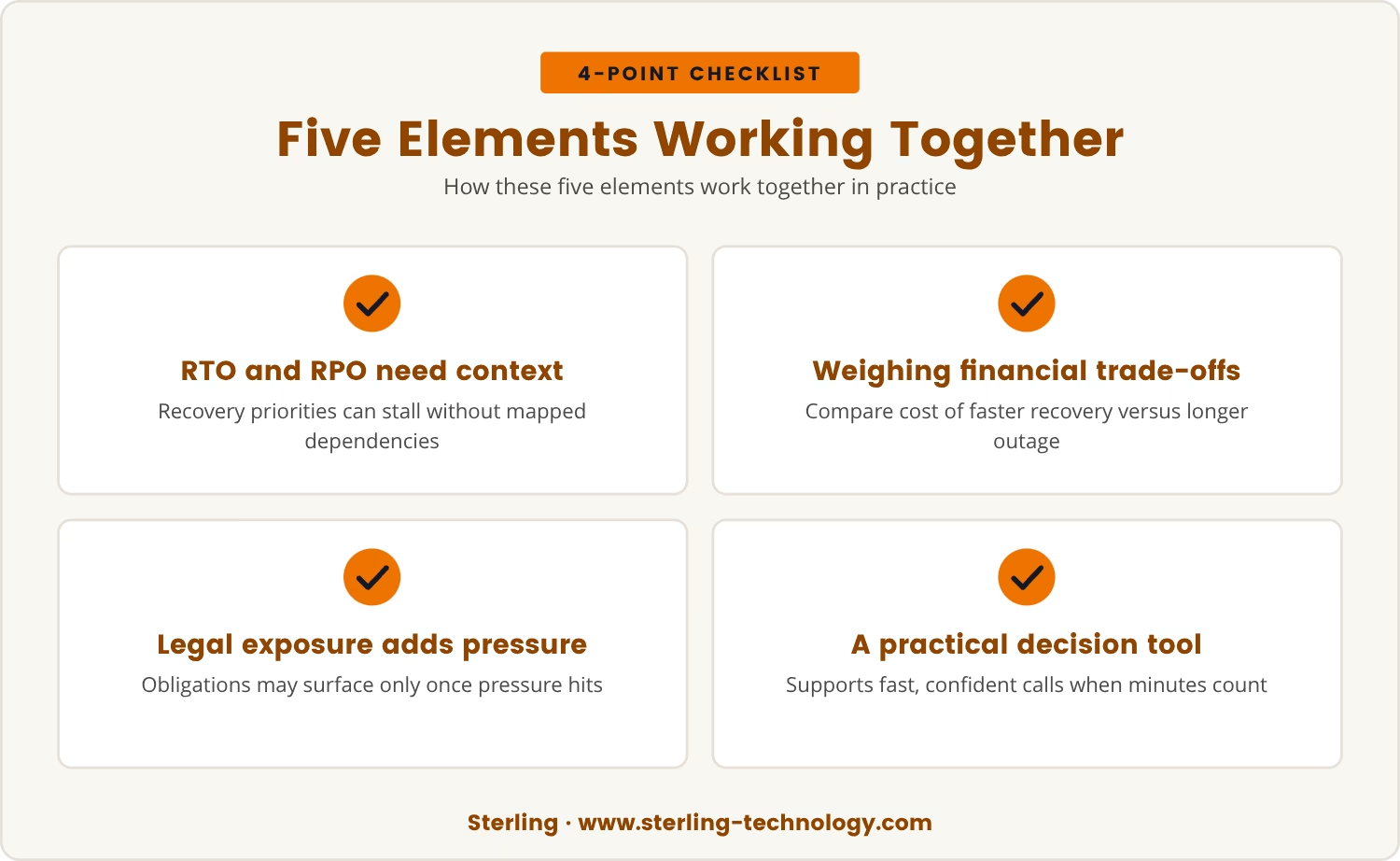
RTO and RPO, for instance, set the priorities for recovery — but without resource dependencies mapped alongside them, a critical process can stall anyway because a key supplier is offline. The pieces only work as a system.
Financial impact over time adds a way to weigh trade-offs, such as paying for faster recovery versus accepting a longer outage. Legal and contractual exposure then adds a further layer, forcing a look at obligations that might not surface until the pressure is already on.
With all five elements in place, the BIA functions as a practical tool rather than a checklist to file away. It supports decisions made quickly and with confidence, in the moments when every minute counts.
Building a practical BIA vs risk assessment: What's the difference?
A business impact analysis and a risk assessment get confused often, but they serve different purposes. A risk assessment identifies threats and vulnerabilities — what could go wrong and how likely it is — while a BIA focuses on what happens once those risks become reality.
A risk assessment might flag a power outage as possible. The BIA, by contrast, spells out how long the business can operate without power, what it will cost, and what needs restoring first — which is what makes it the roadmap for recovery.
Blend the two inside a single template, and important details can slip through right when getting back to business matters most. Keeping them separate is what keeps the continuity plan both realistic and actionable.
How to conduct a BIA that closes every gap
Conducting a thorough BIA takes more than filling out a template line by line. Start by identifying critical business functions and mapping their dependencies, then define the RTO and RPO for each one and calculate the financial impact of downtime as it accumulates over time.
From there, turn to contracts and legal obligations. Are there penalties for missing deadlines? Do service level agreements demand a specific response time? Documenting these exposures now is what keeps them from becoming surprises later.
Finally, test the analysis against a scenario — a major outage, say — and see whether the plan actually holds up under it. Wherever a gap turns up, that's the signal to update the template with the missing element.
What happens when you skip one of the five elements
Leaving out any one of the five key elements creates a blind spot that surfaces only once an actual outage is underway. Skip a clear RPO, for instance, and systems might get restored only to reveal that critical data never made it back. Skip the resource-dependency mapping, and time gets wasted fixing systems that can't function without external support anyway.
Financial and legal gaps carry the steepest cost of all. Without a sense of how losses accumulate over time, recovery decisions get delayed in ways that balloon the final bill, and a missed contractual obligation can damage relationships or trigger fines on top of everything else.
A complete BIA template stands as the clearest defense against these surprises, turning the continuity plan into a living document that helps a team act fast and sidestep costly mistakes.

Why a tailored approach matters for your continuity plan
Many companies with 20 to 80 employees rely on templates that seem complete but miss details that only show up during a real disruption. At Sterling, we know how quickly a missing piece in your plan can become a real problem.
We invite you to see how our team approaches business impact analysis and continuity planning, or to start a conversation about your own setup. Let’s make sure your plan is ready for anything.
See how fast response closes the gap
Get the benefit of our average response and resolution time of only 30 minutes—so your business isn’t left waiting when every minute counts.
Frequently asked questions
How often should a business impact analysis be updated?
A business impact analysis should be reviewed and updated at least once a year, or whenever major changes occur in business operations, systems, or staff. Regular updates keep the continuity plan relevant as the organization grows or changes.
What is the difference between a BIA and a risk assessment?
A business impact analysis focuses on the consequences of disruptions — how they affect operations and what's needed to recover. A risk assessment identifies potential threats and vulnerabilities instead. Both matter, but they answer different questions about the business.
How do I identify critical business functions for my BIA?
Start by listing all business processes and asking which ones are essential for the operation to continue. Consider which activities generate revenue, support customers, or are required by law or contract, and prioritize whichever would cause the most serious impact if disrupted.
What role does documentation play in a BIA?
Accurate documentation keeps a BIA usable and actionable over time. Clearly recorded findings, resource dependencies, and recovery objectives make it far easier for a team to respond quickly and effectively during an outage.
How can I ensure my BIA meets compliance requirements?
Review relevant regulations and standards, such as ISO 22301, to confirm the BIA addresses every necessary area. Consulting legal or compliance experts helps when requirements are unclear, and the analysis should be updated as those requirements change.

Landon Carter
Outside of work I enjoy traveling with my wife and son, helping coach little league baseball teams, and cheering on the Carolina Panthers.


