The Overlooked Impact of Employee Cyber Training on Insurance Decisions
November 27, 2026

Skipping structured employee cyber training can quietly increase both the cost and the time it takes to secure cyber insurance. Even without a breach, lacking documented training may lead to higher premiums or denied claims.
A policy denial doesn't always trace back to a breach — it can trace back to a filing cabinet missing the right paperwork.
When a business skips structured employee cyber training, the gap rarely shows up as a security failure; it shows up later, as a cost, a delay, or a claim an insurer refuses to honor.
That's because insurance providers look for more than technical defenses. They want proof that people know what to do when something goes wrong, and if your training program is informal or undocumented, that gap quietly shapes how insurers judge your risk.
Many companies focus their energy on stopping cyber threats outright, which makes sense until the real test arrives: applying for or renewing cyber insurance. At that point, a missing record of employee training can mean higher costs, slower approval, or no coverage at all.

How insurance underwriters view cybersecurity training
Insurance underwriters exist to measure risk, so a firewall and a antivirus license only tell part of the story they're reading. What they actually want to know is whether the people behind those defenses are prepared to recognize and avoid threats in the first place.
A documented cybersecurity training program answers that question by signaling that employees are less likely to fall for phishing or similar attacks, which lowers the risk underwriters assign to the business. Without that documentation, the same business can look like a bigger gamble, regardless of how strong its technical setup is.
That perception compounds over time: higher premiums, longer approval processes, even denied claims if an incident occurs. In other words, skipping formal training doesn't just leave a security gap — it reshapes the entire risk profile an insurer assigns to the business.
The hidden costs of skipping structured training
Many businesses in Charlotte assume that a clean breach history should keep their insurance rates low. Insurance companies, however, tend to price for preparation, not just track record.
Skipping structured employee cyber training might save time upfront, but that savings doesn't disappear — it resurfaces later as a cost. Insurers may respond by requesting extra documentation, ordering additional audits, or simply delaying policy approval.
Those delays land hardest when timing matters most, say when coverage is needed to close a deal or satisfy a client requirement. The waiting and the extra back-and-forth add up, quietly inflating the true cost of insurance well beyond the premium itself.
Why employee cyber training matters for your insurance
Employee cyber training is more than a compliance checkbox — it functions as a key input in how insurance companies size up a business. A clear, ongoing training program is how that input gets made visible, demonstrating that a team is actually ready to handle threats rather than simply aware they exist.
Insurers read that readiness as lower risk, and they tend to price it accordingly: better rates, faster underwriting, more favorable terms. Flip the picture, and inconsistent or undocumented training can mean higher premiums or denied claims, regardless of whether a breach ever actually happens.
For businesses in Charlotte, that trade-off reframes what structured training is for. It isn't only about stopping attacks — it's about protecting the bottom line in ways that rarely show up until an insurer starts asking questions.
What underwriters look for in a cybersecurity training program
Underwriters don't assess training on instinct; they check it against specific criteria. The main elements they look for break down as follows:
Documented training schedule
Underwriters want to see that training happens regularly and is tracked over time. A one-time session isn't enough — they're looking for an ongoing effort, not a single event.
Customized content for roles
Not all employees face the same risks, so generic training only goes so far. Effective cybersecurity training tailors lessons to different job functions, so everyone learns what's most relevant to their own work.
Proof of participation
Attendance records or completion certificates show that a team actually took part in training, not just that a program existed on paper. That documentation can be the deciding factor when proving training efforts to an insurer.
Testing and assessment
Quizzes or practical exercises confirm that employees understood the material rather than just sitting through it. Underwriters may specifically ask for evidence that a team can apply what it's learned.
Updates for new threats
Cyber threats shift quickly, so a static training program ages out of relevance fast. Insurers want to see the material updated regularly to cover new risks and attack methods as they emerge.
Clear policies and procedures
Training works best when written policy backs it up, turning lessons into standard practice. Underwriters look for clear guidelines on how employees should respond to incidents or suspicious activity.
Common ways training gaps affect insurance outcomes
Even strong technical defenses can't fully offset weak or missing training, and the effects surface in several concrete ways:
- Higher premiums: Insurers may charge more if they see a business as higher risk due to lack of training.
- Longer underwriting: Approval can drag out when clear training records aren't available to review.
- Coverage limits: Some policies exclude certain types of incidents if employee training can't be demonstrated.
- Denied claims: Without proof of training, insurers may refuse to pay out after an incident, even when the breach wasn't the business's fault.
- Extra requirements: Insurers might require new training to be implemented before finalizing a policy, adding unexpected steps and costs.
How to make your training program insurance-ready
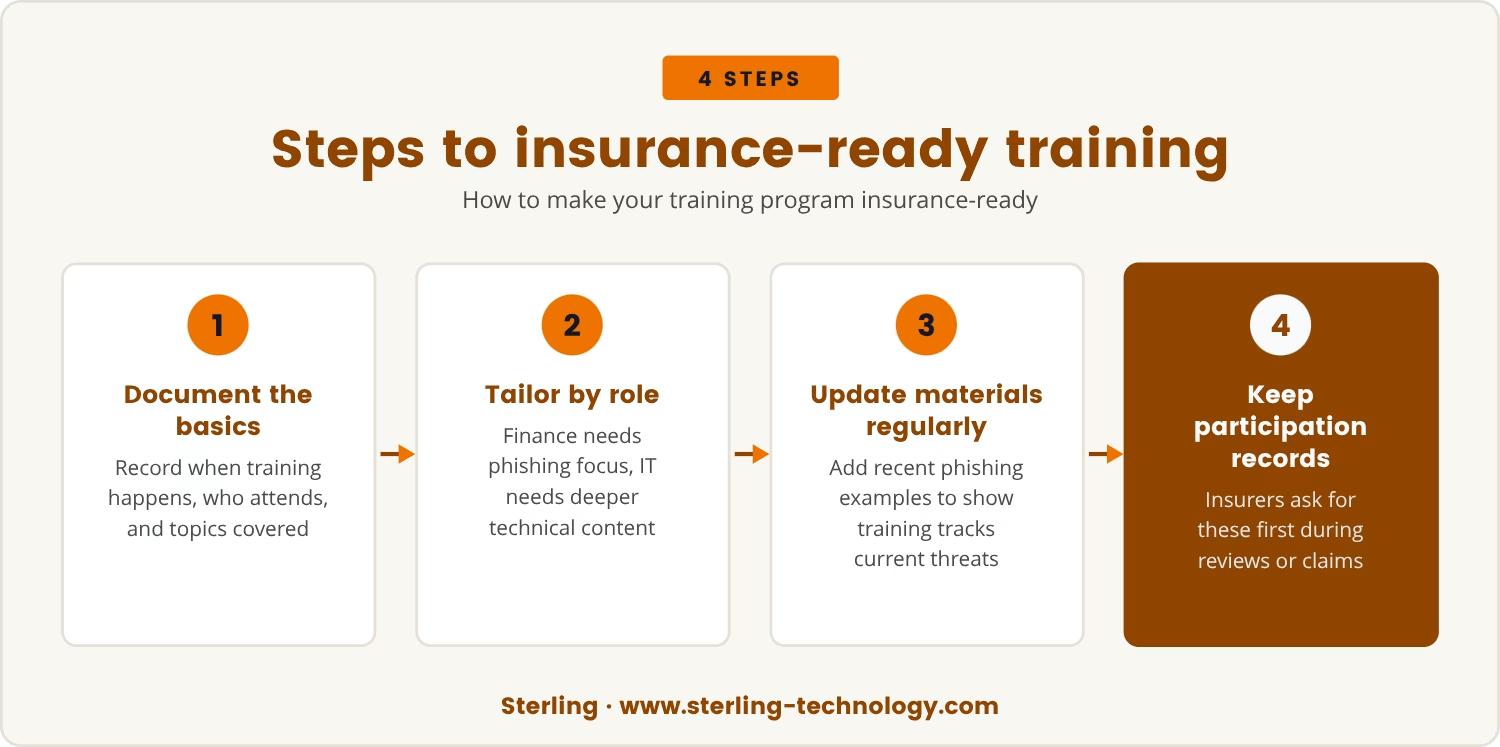
Building a training program that satisfies insurers doesn't have to be complicated, and the starting point is simply documentation. Write down when training happens, who attends, and what topics get covered, even if the process so far has been informal.
From there, tailor training to the different roles within the business: finance teams likely need extra focus on phishing, while IT staff may need deeper technical content.
Materials should also evolve alongside the threats they cover. Something as simple as adding recent phishing email examples shows insurers that the training keeps pace with current risks.
Finally, keep records of participation and test results, since these are exactly what an insurer will ask for first — whether during a routine review or a claim.
Have you reviewed your current training records to see if they meet these standards?
The long-term value of proactive training
Investing in structured training pays off along two tracks at once. It helps a team avoid mistakes day to day, and it simultaneously positions the business as a lower risk in the eyes of insurers.
Over time, that lower-risk standing translates into better insurance terms, fewer delays, and more predictable costs. Even absent a breach, a documented training program still pays dividends in financial stability and peace of mind.
For businesses with 20 to 80 employees, the effort invested in training now heads off bigger headaches later. The hidden costs of skipping this step tend to surface exactly when they're least convenient — during insurance reviews, renewals, or claims.

Why your training records matter more than you think
Many businesses with 20 to 80 employees don't realize how much their insurance rates and claim outcomes depend on documented training. At Sterling, we see how this detail can quietly shape your coverage and costs.
If you're unsure whether your current approach meets insurer expectations, we're ready to talk about how we help businesses like yours close these gaps.
Want faster insurance answers for your training questions?
Qualifying businesses can rely on our average response and resolution time of only 30 minutes for support or documentation requests tied to insurance needs.
Frequently asked questions
What counts as a "structured" cybersecurity training program for insurance purposes?
A structured program is planned, documented, and repeated on a regular basis rather than delivered once and forgotten. Insurers look for evidence of an ongoing process, with clear records of participation and content that gets updated over time.
How often should employee training be updated to satisfy insurance requirements?
Most insurers expect training to be refreshed at least annually, though more frequent updates — particularly as new cyber threats emerge — signal a higher level of preparation. Regular updates help keep a team ready for current risks rather than outdated ones.
Can online training courses meet insurance standards for cybersecurity education?
Yes, online courses can satisfy insurance standards when they're part of a broader training plan rather than a standalone effort. Insurers want courses relevant to employees' actual roles, backed by records of completion and assessment.
What happens if a claim is denied due to lack of security awareness training?
If a policy requires proof of training and none can be produced, an insurer may deny the claim even when negligence played no role in the incident. That's what makes clear records of security awareness training essential to protecting coverage.
Are there specific best practices for documenting employee training?
Best practices include keeping detailed records of training dates, attendance, topics covered, and test results. Storing this information in a secure, easily accessible format makes it possible to respond quickly to insurer requests or audits.

Landon Carter
Outside of work I enjoy traveling with my wife and son, helping coach little league baseball teams, and cheering on the Carolina Panthers.


