M&A IT Integration: Why the Roadmap Stalls Before It Starts
November 17, 2026

Integration management offices must make five key decisions before migration begins, not after. Early choices keep the integration roadmap moving and prevent costly stalls once technical work starts.
It's widely assumed that M&A IT integration lives or dies on technical execution—whether the systems connect cleanly, whether the migration runs without a hitch. In practice, the trouble almost always starts earlier, in decisions left unmade until the last minute.
Those delayed choices, not faulty technology, are what produce the delays, the confusion, and the unexpected costs that derail a migration. A successful merger or acquisition depends on more than just connecting systems; it depends on groundwork laid long before anyone moves a single file or server. Wait until the end to make the big calls, and progress stalls exactly when the technical work should be picking up speed.
For businesses in Charlotte, this timing matters even more, since these early decisions shape how well teams align and how quickly value is realized. Without a clear plan up front, even the best technology can't deliver the synergy a merger or acquisition is supposed to produce.

The hidden impact of early integration planning
Most teams know they need an integration plan, yet few realize how much early decisions shape everything that follows. The moment a technology migration begins, every question left unresolved turns into a potential roadblock.
If nobody has agreed on which systems to keep, who leads each part of the project, or how data will be handled, the team ends up pausing for answers at the exact moments it should be moving forward. The squeeze is tightest for businesses with 20 to 80 employees, where resources are thin, and every delay costs real time and real money.
Early planning, then, is not just a checklist exercise. It means making the right calls before the technical work starts, so the roadmap stays clear once things are in motion. Decisions made up front translate directly into an integration that moves faster and throws fewer surprises.
Five decisions that shape your integration strategy for mergers
Before any migration starts, an integration management office needs to settle five critical points, and each one heads off a different kind of stall later on.
1. Scope and priorities
Decide exactly which systems, applications, and data will be integrated, and in what order. Settling this up front avoids confusion and keeps teams from working at cross purposes.
2. Leadership and accountability
Assign clear roles for decision-making, project management, and technical execution. Once everyone knows who owns what, issues get resolved faster instead of stalling in limbo.
3. Data governance rules
Set policies for how data will be migrated, cleaned, and secured. Skip this step, and the risk shifts to data loss or compliance problems down the line.
4. Communication protocols
Agree on how updates, changes, and issues will travel between teams. That shared rhythm keeps everyone aligned and cuts down on misunderstandings.
5. Success metrics
Define what a successful integration actually looks like. With that definition in place, teams focus on outcomes instead of just tasks, which makes it easier to spot problems early.
Why M&A IT integration decisions can't wait until the end
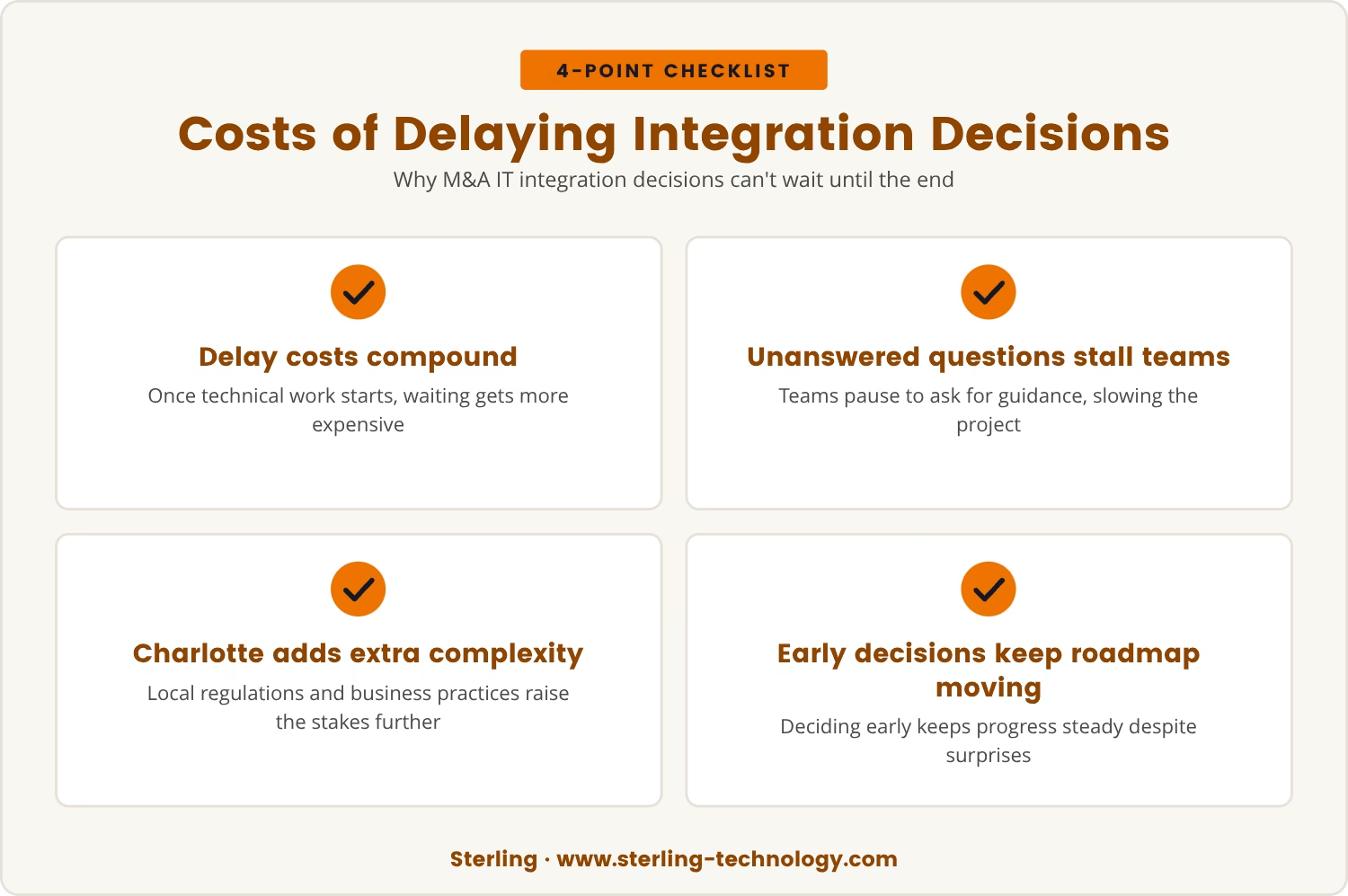
It's tempting to think these problems can be solved as they come up, but waiting rarely works that way in practice. Once the technical work is underway, delay has a cost that compounds.
Every unanswered question becomes a bottleneck: teams stop to ask for guidance, and the project slows down accordingly. If nobody decided in advance how to handle duplicate user accounts, for instance, a migration might need to pause halfway through just to sort it out.
The stakes run higher still for companies in Charlotte, where local regulations and business practices add extra layers of complexity to an already tight process. Deciding these questions early is what keeps the integration roadmap moving even when something unexpected comes up.
Building your day one IT readiness checklist
A strong checklist does more than list tasks; it makes sure nothing slips through before the migration starts. The key items to include:
- System inventory: List every application, server, and device that will be affected.
- Data mapping: Identify where data lives and how it will move.
- User access planning: Decide who needs access to what, and when.
- Risk assessment: Flag potential issues and plan how to address them.
- Communication plan: Outline how updates and changes will be shared.
Each item on this list traces back to one of the five decisions above, which means skipping any of them leaves a gap exactly where the real work begins.
The role of integration management in post-merger success
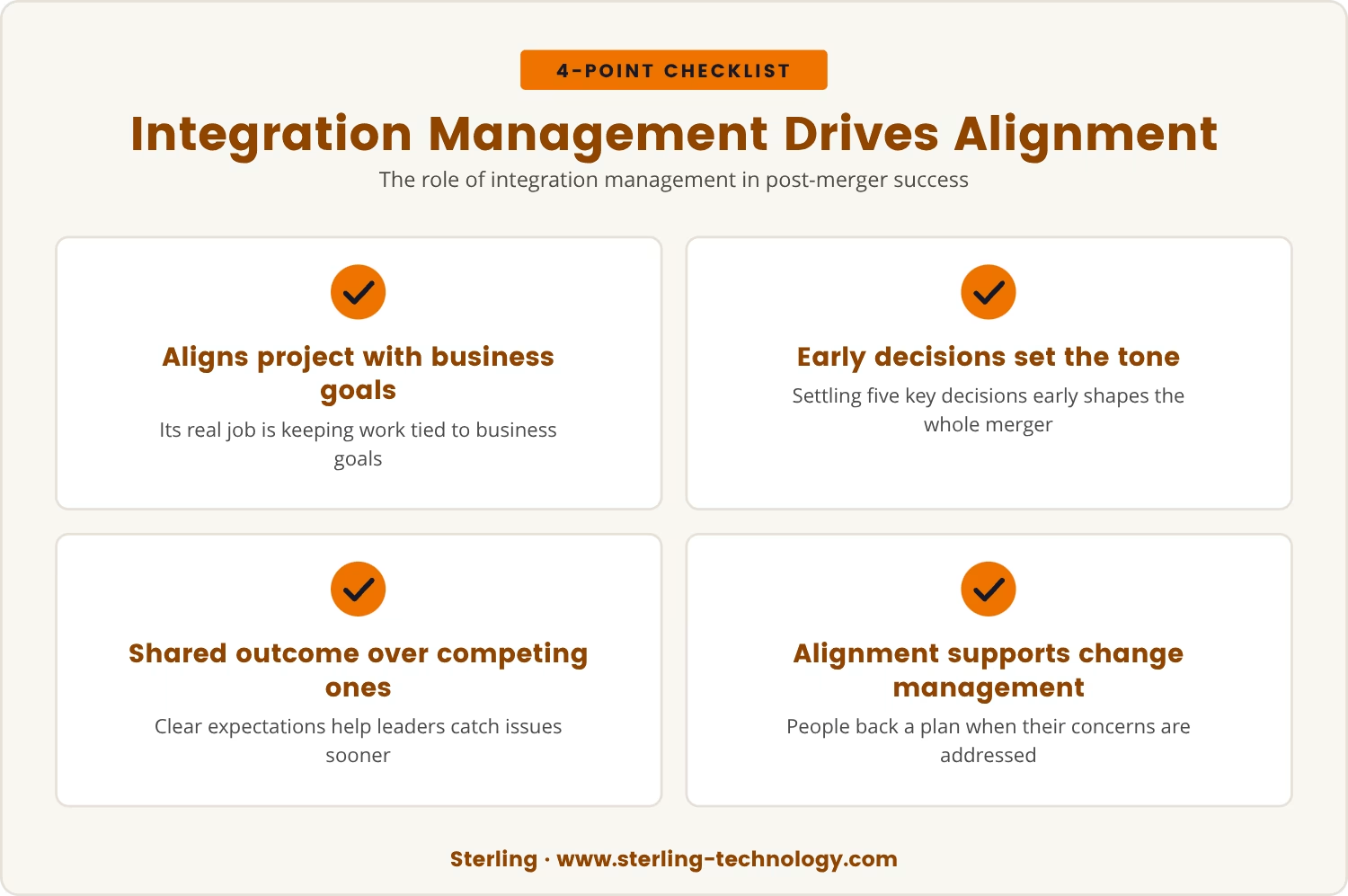
Integration management covers more than the technical side; its real job is keeping the whole project aligned with business goals.
When an integration management office settles those five decisions early, it sets the tone for the entire merger or acquisition. Teams know what to expect, leaders catch issues sooner, and the work points toward one shared outcome instead of several competing ones.
That alignment also feeds change management directly. People support a process more readily when they understand the plan and can see their concerns addressed from the start.
Avoiding common pitfalls in technology integration
Many integration projects stumble over the same handful of problems: unclear priorities, last-minute changes, misaligned teams. Trace any of them back far enough, and the root is almost always a decision that got delayed or skipped entirely.
Focusing on early decision-making heads off:
- Scope creep: When the project grows beyond its original plan.
- Duplicate work: When teams don't know who is responsible for what.
- Data issues: When rules for handling data aren't set in advance.
- Communication breakdowns: When updates and problems aren't shared clearly.
- Missed targets: When success metrics aren't defined up front.
Any one of these can slow an integration to a crawl or sink it outright, which is exactly why early planning functions as the best defense available.
What to do next: Keeping your integration roadmap on track
Anyone preparing for a merger or acquisition should use this moment to review their integration approach. Have these five decisions actually been made, or does the project risk stalling the instant technical work begins?
A clear, well-communicated integration plan keeps a team focused and narrows the room for surprises. For businesses in Charlotte, that translates into smoother transitions and faster value creation from the merger or acquisition.

How Sterling helps Charlotte businesses prepare for integration
If your business has 20 to 80 employees, you know how quickly an M&A IT integration can become overwhelming without the right groundwork. At Sterling, we see how early decisions shape the entire process and help prevent costly delays.
We invite you to see how our team approaches integration planning and what a conversation about your own roadmap could look like.
See how fast integration issues get solved
Experience an average response and resolution time of only 30 minutes when you work with us on your integration needs.
Frequently asked questions
What is the difference between an integration plan and a checklist?
An integration plan sets the overall strategy, goals, and direction for merging systems and processes after a merger or acquisition. A checklist breaks that plan into specific, actionable items so nothing gets missed during execution.
How does change management affect technology integration?
Change management helps employees adapt to new systems and processes during integration. Addressing concerns, providing training, and communicating clearly reduces resistance and smooths the transition for everyone involved.
Why is due diligence important before starting IT integration?
Due diligence surfaces the systems, data, and risks tied to a merger or acquisition before work begins. That early visibility supports better decisions about what to integrate, fewer surprises, and clearer plans for any challenges ahead.
What should an integration management office focus on during a merger?
The integration management office should focus on aligning teams, setting clear priorities, and monitoring progress. Its role is keeping everyone pointed at the same goals, resolving issues quickly, and making sure the integration delivers the value it promised.
How can we measure the success of our post-merger integration?
Success shows up in how well the new systems work together, how quickly teams adapt, and whether the business hits its goals. Tracking metrics such as system uptime, user adoption, and cost savings shows whether the integration is actually delivering.

Landon Carter
Outside of work I enjoy traveling with my wife and son, helping coach little league baseball teams, and cheering on the Carolina Panthers.


