SEC Cybersecurity Rule Alters the Risk Picture for Business Relationships
October 23, 2026
A rise in sector-wide cyber incident disclosures can make your company look riskier to outsiders, even if your own security hasn’t changed. This shift can affect financing, insurance, and partner trust.
When cybersecurity disclosures spike across an industry, the fallout is not limited to the companies that had incidents: financing can get harder to secure, insurance premiums can climb, and partners can grow hesitant to sign contracts, all without a single change inside your own walls. That is the quiet cost of the SEC cybersecurity rule.
A single shift in disclosure requirements can ripple through how others judge your business. When public companies started reporting more incidents, the volume of disclosures rose by 60%. The shift is not just about transparency—it's about how your risk gets measured against everyone else's numbers.
That measurement problem starts with the rule itself. The SEC cybersecurity rule asks public companies to report material cybersecurity incidents quickly and in detail, so investors, insurers, and partners can make informed decisions. But once everyone is reporting more, your company's risk profile can shift relative to your peers even though your actual security posture hasn't budged.
As a result, your business ends up judged not just by what it does, but by what's unfolding across the sector around it. Recognizing that distinction is the first step toward preparing for how others may start to view your company.

How incident disclosure volume changes risk perception
A rise in the number of reported cybersecurity incidents does more than fill up annual reports: it resets the way outsiders judge your company's baseline risk. When the SEC requires more detailed and frequent disclosures, an entire sector's risk profile can appear higher almost overnight.
That overnight shift matters because investors, insurers, and business partners lean on these disclosures to compare companies side by side. If your sector suddenly looks more exposed, your company may get grouped in with higher-risk peers even when your own controls remain strong.
Consider a business in Charlotte that keeps its security practices steady while the industry's overall disclosure numbers jump; lenders and partners may still start to see the whole region as riskier. That perception, once formed, can affect financing terms, insurance premiums, and even other companies' willingness to do business at all.
So the real impact isn't confined to your own security; it's about how your risk gets measured against a moving target. The more incidents your peers report, the more you may need to explain why your risk hasn't actually changed.
Why more disclosures don't always mean more risk
It's tempting to read a spike in reported incidents as proof that things are getting worse. Yet the SEC's rules on cybersecurity risk management are built to make reporting more consistent, not to expose a sudden new wave of threats.
Many companies are now disclosing incidents that would have gone unreported before, which means attacks aren't necessarily more common, just more visible under the new rules. In other words, the rise in numbers is often a story about transparency rather than a sudden increase in danger.
Even so, outsiders may not draw that distinction. They might use the higher numbers to judge your company's risk regardless of whether the real threat has changed, opening a gap between perception and reality that can be hard to close.
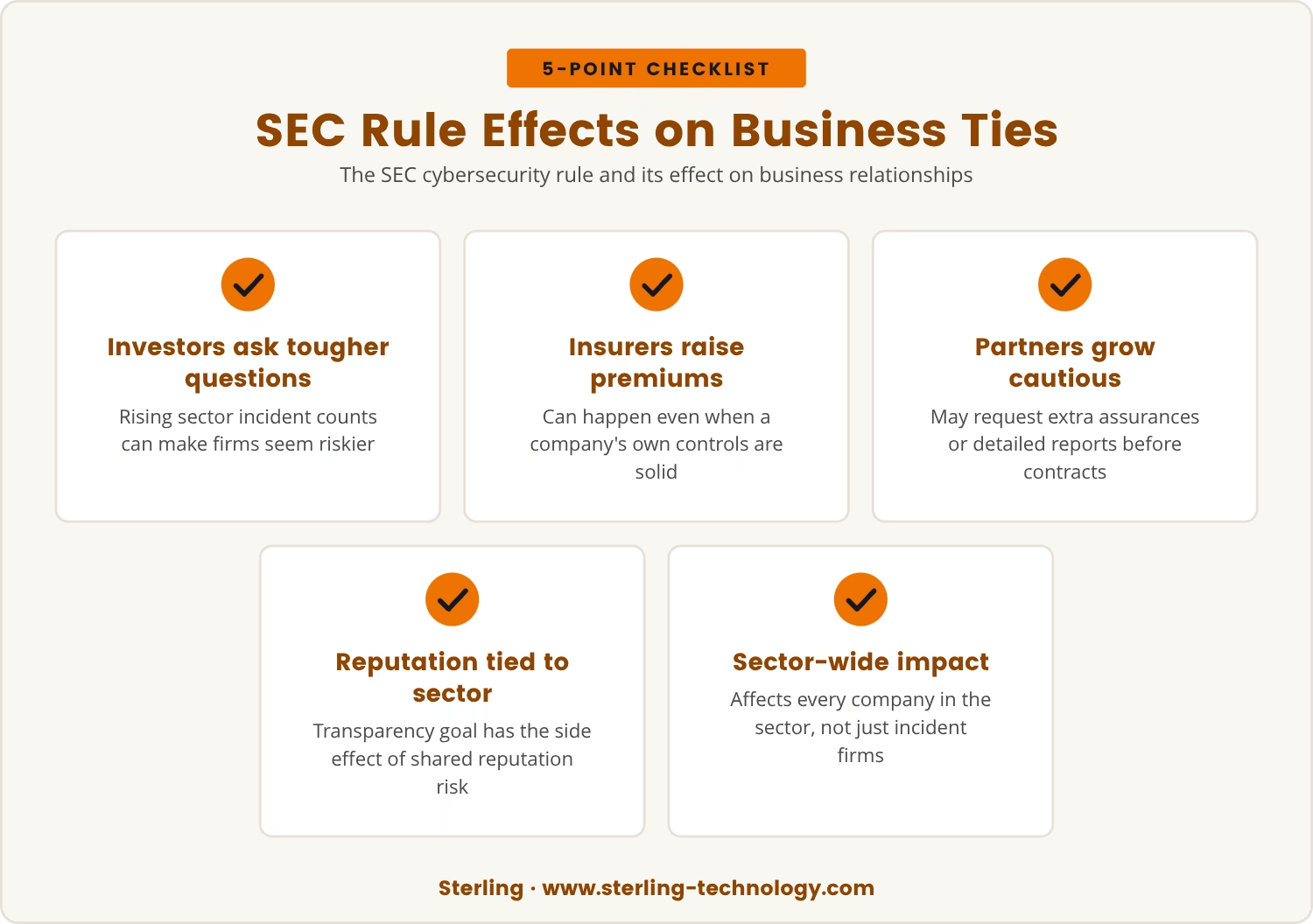
The SEC cybersecurity rule and its effect on business relationships
The SEC cybersecurity rule is reshaping how companies interact with investors, insurers, and partners. As more incidents get disclosed, the baseline for what counts as "normal" risk keeps moving.
Investors may view your company as riskier simply because your sector is reporting more incidents, which can translate into tougher questions during funding rounds or due diligence. Insurers, following the same logic, might raise premiums or add exclusions to policies even when your own controls are solid.
Business partners tend to grow more cautious in turn, asking for extra assurances or more detailed reports before signing contracts. The rule's intent is to improve transparency, but its side effect is that your company's reputation can end up shaped by the actions of others in your sector.
Businesses in Charlotte might notice these ripples in local business discussions or in the terms banks and insurers start offering. The rule touches everyone in the sector, not just the companies that have actually had incidents.
What investors and insurers look for after disclosure changes
As the volume of cybersecurity disclosures rises, investors and insurers recalibrate how they judge risk, and they don't stop at your incident count; they weigh it against what's happening across the industry.
Key factors they consider:
- Relative incident volume: how your disclosures stack up against peers, not just your own history.
- Detail in reports: whether you describe the material impacts of incidents, not just the fact that they happened.
- Consistency: whether your reporting matches what others in your sector are doing, or stands apart.
- Response quality: how quickly and thoroughly you respond to incidents, as reflected in your disclosures.
- Sector trends: broader patterns in your industry that might affect everyone's risk profile at once.
Taken together, these factors mean your risk rating can shift based on what others report, even when your company's own security hasn't changed at all. That, in turn, can affect your access to capital, your insurance terms, and how much partners trust you.
How to manage your company's risk profile in a changing disclosure landscape
Staying ahead of perception shifts matters as much as managing the underlying cybersecurity risks themselves. A few practical steps can help:
- Monitor sector disclosures: track how many incidents are being reported in your industry so you understand where you stand.
- Communicate context: when you report an incident, explain how it fits into sector trends, and make clear if a rise reflects new rules rather than new threats.
- Review insurance policies: check whether premiums or terms have changed since disclosure volumes increased, and talk to your broker about how your risk is being assessed.
- Prepare for investor questions: be ready to explain your risk controls and how you compare to peers, with clear answers about your cybersecurity risk management.
- Strengthen partner trust: offer transparency and context in your communications, showing that you understand the new disclosure environment and are staying ahead of it.
Taken together, these steps can help you stay in control of your company's risk profile even as the landscape shifts around you.
The hidden consequence: shifting baselines and business decisions
The most unexpected result of the SEC's new disclosure requirement is how quickly the baseline for risk can move. When everyone is required to share more, a company once seen as low-risk can suddenly look average, or even high-risk, by comparison alone.
That shift can ripple into everything from loan approvals to partnership opportunities, since the judgment isn't just about your own actions but about how your company measures up against a new standard set by the entire sector.
For companies with 20 to 80 employees, this means watching not just your own security but how your industry as a whole is being perceived. The rules demand transparency, but they also create new challenges in managing reputation and relationships alongside it.

What to do when your risk profile changes unexpectedly
If your business has 20 to 80 employees, you might be surprised to find your risk profile shifting even when your security practices stay the same. At Sterling, we understand how disclosure rules can affect your relationships with investors, insurers, and partners.
We invite you to see how we approach these challenges and to talk with us about your company’s unique situation. Let’s look together at how your risk is being measured and what you can do about it.
Want faster response when risk perceptions shift?
Get the benefit of an average response and resolution time of only 30 minutes—available to businesses that qualify, so you’re never left waiting when issues arise.
Frequently asked questions
How do the new SEC cyber disclosure requirements affect small and midsize businesses?
The new requirements mainly target public companies, but their effects reach smaller businesses through supply chains and partnerships. A business that works with public companies may be asked to share more information about its own cybersecurity practices, which can mean extra paperwork or new questions from partners even without direct SEC regulation.
What is considered a material cybersecurity incident under the disclosure rule?
A material cybersecurity incident is one that could impact a company's financial health or influence an investor's decision, including breaches that disrupt operations, expose sensitive data, or cause high costs. Companies must judge materiality based on an incident's potential to affect business decisions, not simply its technical scale.
How can registered investment advisor cybersecurity practices be adapted to meet new expectations?
Registered investment advisors can review their cybersecurity risk management policies to ensure alignment with current disclosure expectations, including updated incident response plans, staff training on new reporting requirements, and clear documentation for clients and partners. Staying proactive on these fronts helps advisors maintain trust while meeting regulatory standards.
Will the SEC's final rule on cybersecurity disclosure change how investors evaluate risk?
Yes, the final rule increases transparency, giving investors more data to compare companies against one another. That added visibility can bring more questions about cybersecurity controls and how disclosures compare across a sector, so clear and detailed reporting helps manage investor perceptions.
What steps can public companies take to reduce negative impacts from increased disclosure volume?
Public companies can focus on providing clear, factual information in their disclosures and explaining the context behind reported incidents. Regularly reviewing and updating cybersecurity policies, paired with open communication with stakeholders, helps reduce misunderstandings and maintain trust as disclosure volumes rise.

Landon Carter
Outside of work I enjoy traveling with my wife and son, helping coach little league baseball teams, and cheering on the Carolina Panthers.


